Latest Posts

Hygge is… Watering the Flowers


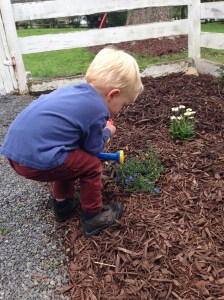
My toddler son was screaming and protesting – he was not ready to go inside. I let him stay in the backyard longer and he went to get his little blue watering can. As soon as he started watering the flowers he was in a zone of peaceful hygge. I believe he was even humming to himself. It was such a pleasure to watch him that I instantly felt the calm of this hygge event in the warm afternoon sun.

That same evening after the kids were put to bed, instead of cleaning dishes I went outside and watered the flowers. It was a very nice feeling, just being outside on a quiet warm spring evening helping the flowers grow. There is something satisfying about watering plants. Perhaps because it reminds us to appreciate nature and its beauty. It brings happiness and a peaceful patience to watch plants grow and makes us feel like we are doing something meaningful and rewarding. If you truly take your time to enjoy the task of watering it is quite hyggeligt.

Spring and summer can be so full of hygge and I cannot wait for the weather to turn warmer again so I can create hygge nooks in our backyard. And if you are in doubt about how to find hygge and happiness just let children guide you – they seem to know all about enjoying the simple pleasures of nature and being in the moment…

IMG_0912

Friday Cake: Danish Cinnamon Rolls

Spring is here in full bloom with 85 degrees fahrenheit outside. I would never have thought I was going to call 85 degrees “spring weather” – those temperatures would be characterized as a “heat wave” in Denmark. Warm weather obviously calls for a different kind of hygge than wool socks and hot chocolate. But this does not mean that you cannot hygge when it is hot outside! It is just a different kind of hygge. It is almost more hygge with warm weather because it gets most of us outside and the outdoors is relaxing. Alright, enough talking – lets get to the cake;)

The cake I have made for this week’s Friday hygge is Danish cinnamon rolls or Kanelsnegle as they are called in Denmark. I make them with a bun-like dough and not with real Danish pastry dough which needs to be rolled out so many times I have never even tried it. Besides, in Denmark you can just go to the bakery for the “real” danishes so why even bother making them yourself.

Anyway, these homemade doughy cinnamon rolls are quite a big hit with my husband and children. While I love to indulge in an American cinnamon roll the Danish ones taste of home and childhood to me – and I am still able to do something after eating one of them:-)

This recipe is an adapted version of a Kanelsnegle recipe in the classic Danish cook book Frøken Jensens Kogebog.

P1010299

Danish Kanelsnegle/Cinnamon Rolls

Danish Cinnamon Roll Recipe (Kanelsnegle)

Ingredients

1/4 cup water

1 package active dry yeast

1/2 tsp sugar

3/4 cup whole milk

7 tbsp butter

1/4 tsp salt

1/2 tsp cardamom

3.5 oz/100 gram sugar

About 5 cups all-purpose flour

Filling:

4 tsp cinnamon

1 sticks and 4 tbsp butter, soft

3.5 oz/100 gram sugar

Icing:

Powdered sugar

Water

How you do it:

Proof the yeast in 1/4 cup of warm water with 1/2 tsp sugar. When it bubbles add it to a standing mixer bowl.

Melt butter in a little pot and when it is melted you warm the milk with it (without boiling just until lukewarm). Then you add it to the yeast in the mixing bowl. Stir until well mixed. Next you add egg, salt, cardamom and sugar. Knead in the flour a little at a time. This is the tricky part because you do not want too much flour, only enough so it forms a ball. Make sure it is not a dry dough so if there is too much flour in it you add more water to it, one tablespoon at a time. Cover and rise for 1-2 hours.

Meanwhile, you make the filling by beating butter, sugar and cinnamon together in a separate bowl.

When the dough is done rising you roll it with a rolling pin so it becomes a square of about about 16×16 inches. Spread the filling evenly over the dough square and then roll into a roll with the filling inside. Cut the roll into 1 inch slices and place them on two baking sheets lined with parchment paper. Press them gently flat. Cover and let rise for about 1/2 an hour. Glaze them gently with a whisked egg and bake on 390 degrees fahrenheit for about 15 minutes or until golden brown. Once they have cooled off you can ice them with a mix of powdered sugar and water. This is a classic Danish icing. Nice and simple, you just slowly add drops of water to the powdered sugar until it has the right consistency. Enjoy with some coffee or cool white wine and hygge asap!

Next week I will take a little break with the baking so if you are looking for Friday cake inspiration I recommend my first Friday Cake post “Dream Cake”:-)

Friday Cake: Coconut Lime Macaroons

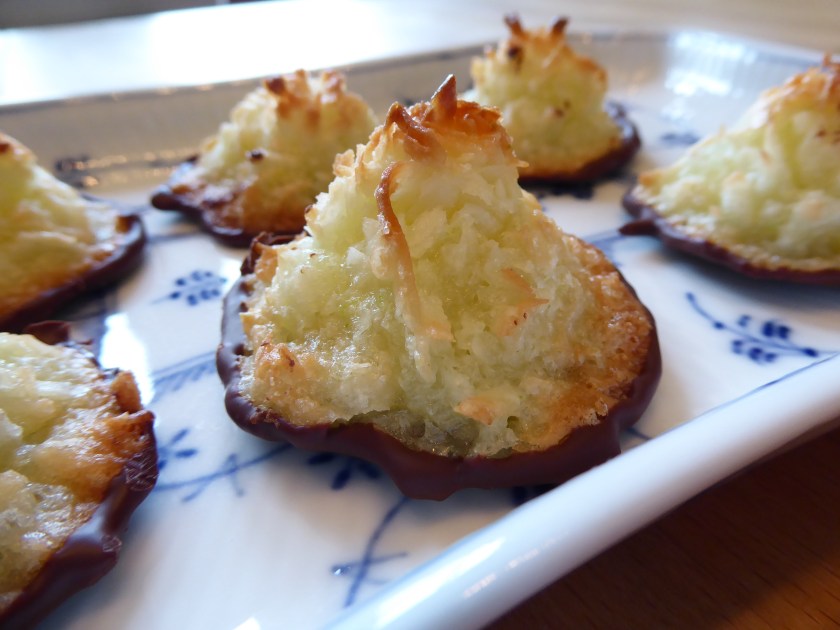
This week’s Friday Cake is ideal for Spring or Summer hygge outside on the porch or in your backyard. It is a fresh take on the classic Danish “Coconut Tops”/”Kokostoppe” with lime added to them. I used an adapted version of Mette Blomsterberg’s recipe (see link here: Kokostoppe med lime og marcipan) and a recipe on Soendag.dk (see recipe here: Kokostoppe klassisk opskrift). You can see my English version below. Lime and coconut really works well together but more importantly, these Coconut Lime Tops are ridiculously easy to make. Mix five ingredients together, form as tops, bake and dip in chocolate. That’s it. I think this will work quite well for me on those hot and humid Maryland Summer days that are here before we know it.

Once again, my Friday Cake did not come out as perfect as I had seen on pictures but as my husband said: “Brown is where the flavour is”. And he was right – the flat ring of melted, caramelized sugar and coconut that formed around the tops was the tastiest part! It had a nice coconut-lime caramel flavor. So you do not have to cut it off as I was trying to get away with! Yet again, lets embrace the charm of the imperfect! Because hygge is not about looking fancy and perfect. Hygge is when you can enjoy yourself and be fully comfortable alone or in the company of others. With or without burned edges..;-)


Coconut Lime Tops Recipe

Ingredients:

250 gram/9 oz sugar

250 gram/9 oz sweetened shredded coconut

4 egg whites

1 1/2 tsp vanilla extract

Finely shredded peel of 1 1/2 organic lime (the other half will be nice in a cooling drink;)

200 gram/7 oz dark chocolate

How you do it:

Mix sugar, egg whites, coconut, vanilla extract and shredded lime peel in a standing mixer. Cover with plastic foil and let the mixture cool off in the refrigerator for about half an hour. Heat the oven up to 390 degrees fahrenheit.

Form the mixture into little round balls, place them on a baking sheet lined with parchment paper and round the balls off to make them top-shaped. You will get about 25-30 tops in total so bake them on two baking sheets. I made my first sheet of tops too big and they couldn’t hold their shape so well. The smaller tops kept the form better.

Bake them for 10-15 minutes till they are a nice golden brown and turn the heat down if they start to look burned. Let them cool off, first on a cooling rack and then in the refrigerator. Meanwhile you melt the chocolate. When the tops have cooled off you dip the bottom of them in chocolate and let them dry upside down. Serve when the chocolate has dried or store them in the refrigerator till you are ready to serve.


Friday Cake: Marble Cake

This week’s Friday cake is a classic from my childhood that my grandmother used to make. It is a chocolate/vanilla Marble Cake or as it is called in Danish “Marmorkage” because of the marbled pattern inside. Even though it is not an Easter cake it somehow reminds me of Easter. Maybe because it has a nice golden glow – or rather, it was supposed to be golden but as you can see on the photo my cake did not turn out so perfectly and got a little burnt. Browse the internet and you will see some nice Marble Cake pictures for sure! Burnt or not, it tastes delicious. Especially because this version has chopped dark chocolate in it. Taste it warm out of the oven and you will love it too!

It is an adapted version of a recipe in the Danish magazine Hendes Verden. See “Hendes Verden” Marmorkage Recipe which is a version with orange added to it and I have seen another version with coffee mixed in with the chocolate. So this is only the beginning – I cannot wait to experiment with fun versions of this pretty cake!

As they say – you learn from your mistakes… and I learned that this cake should not be baked in a ceramic form but in a metal form. It bakes slower in a ceramic pan so I had to add at least half an hour of extra baking time which is how the edges got burnt ;-(

P1010168

How not to bake your Marble Cake! Mine got a little burnt because I used a ceramic form, I think a metal bread pan will work better.


Marble Cake/Marmorkage Recipe:

Ingredients:

200 gram/ 7 oz butter

200 gram/7 oz sugar

3 eggs, separated into egg whites and egg yolks

250 gram/9 oz gram all-purpose flour

1 tsp vanilla extract

2 tsp baking powder

1 deciliter/ ca. 1/2 cup milk

2 tbsp cocoa powder

100 gram/3.5 oz chopped dark chocolate


How you do it:

Butter a metal bread pan. Turn the oven on to 390 degrees Fahrenheit.

Chop the butter into cubes, add the sugar and beat it together in the mixer till it is creamy. Add the egg yolks to the mixture and beat.

In a separate bowl, mix the flour and baking powder well together. Then you slowly blend it into the butter mixture. Then add the milk a little at a time.

In a medium sized bowl beat the egg whites together so they are stiff and then mix it in with the first mixture.

Here comes the fun part! You take out a third of the dough and make it brown by adding the chocolate and cocoa. Now you are ready to make that pretty marble pattern by first making a layer of half the white dough on the bottom of the bread pan, then making a layer with all the brown dough on top of this and finally topping with the last half of the white dough. Next you take a spatula and carefully stick it into the cake dough and stir around in the dough to create the marble effect. But only stir a little bit!

Bake it for 30-40 minutes – or much longer if you use a ceramic pan… Anyway, make sure your cake tester comes out clean before you take it out if the oven. And keep an eye on the cake not getting burned… If it starts getting dark, cover with silver foil and turn the heat down a little. I hope you like it.

Happy Easter to you!


Friday Cake: Chocolate Biscuit Cake

Finally Friday and time for some hygge, coffee and cake 🙂

Today’s cake is my first time making a delicious Danish cake called “kiksekage” or chocolate biscuit cake and I am excited it turned out well! It might also be a little hard to mess this one up since it is as simple as can be. I am almost certain this one is going to achieve international success one day, haha! Biscuits layered with a thick and rich chocolate cream – what’s not to like…? The recipe is an adapted version from the Danish interior design magazine Boligliv and you can find the original version on this link.

Kiksekage Recipe Link

Their website is worth a browse just for the sake of the beautiful photos from inspiring Danish homes. It is my favorite Danish interior design magazine.

P1010149


Ingredients

300 gram (11 oz) dark chocolate (60-70 %), coarsely chopped

1 can sweetened condensed milk (400 gram or 14 oz)

35 gram (1.2 oz) butter

1 vanilla stick (or maybe you could try a little vanilla essence or just leave out the vanilla)

About 20 square biscuits (Leibniz)

Shredded coconut for topping

How you do it:

Cover a regular bread form with plastic foil

Melt butter, chocolate and condensed milk in a small pot over low heat. Make sure you stir constantly because it burns easily. Scrape the vanilla seeds out of the vanilla stick and mix in. Keep stirring until everything is melted and well mixed, then turn the heat of.

Pour a thin layer of this chocolate mixture on the bottom of the bread pan. Then you make a layer of biscuits, followed by a thin layer of the chocolate cream. Continue like this until you have four layers of biscuits and one layer of chocolate on the top.

All you have to do now is to cover the bread pan and put it in the fridge overnight. Next day you leave it out of the fridge for 10 minutes, sprinkle with shredded coconut and voilà you have yourself some hygge cake and are ready for some hyggelige guests:)


Friday Cake: Lemon Cake

Friday is back and it is time to get in the mood for the weekend and hopefully lots of hygge!

These last couple of days the bright Spring sun has been hiding behind grey clouds. So my daughter and I have decided to make a little piece of sunshine in a cake. Here is our lemon cake as yellow as the sun and the daffodils. Its tartness will energize you and bring that Spring vitality back!

I love cakes that you have to cut. They just seem more hyggelige because they are ideal for sharing and togetherness – unless you plan on eating the whole thing by yourself of course… My mother-in-law remembers how lemon cake was one of the cakes they had at the coffee table on the farm on Funen in Denmark. The recipe is based on one of those old family recipes and I have just made a few adjustments to it. Originally the cake is baked in a bread form but I think a round cake will give more of that sunny feeling many of us long for right now.

Happy sunny Spring hygge to you!

Lemon Cake Recipe:

250 gram soft butter

250 gram sugar

250 All-purpose flour

3 tsp baking powder

1/2 dl lemon juice

Shredded peel from half a lemon (organic)

3 eggs

100 gram Maizena corn starch or potato starch


3 tbsp milk

Topping:

Dusted powdered sugar and shredded organic lemon peel. Or you could make a lemon icing from powdered sugar and lemon juice (I just did not have enough powdered sugar…)

How to:

Beat the butter until it is soft and creamy, add the sugar and beat it well. Then add the lemon juice and shredded lemon peel and keep beating. Then you add eggs and Maizena a little at a time while you beat it first gently and then faster again.

In another bowl mix all-purpose flour and baking powder well and add it to the first mixture a little at a time while stirring and adding the milk.

Butter a round cake form (2 liter) and bake it on 350 degrees fahrenheit for 40 minutes and then turn down to 325 degrees and bake for 10 minutes extra or even longer, until a toothpick comes out clean.

Invite someone to enjoy it with you, bring it to work or enjoy a piece with a book and some coffee 🙂

Review: The Little Book of Hygge

I began reading Meik Wiking’s The Little Book of Hygge in the waiting area of my daughter’s dance class and it instantly brought me to the country of beautiful design homes with the perfect hygge lighting and warm drinks on dark winter days.

That is what hygge is all about! Transforming an ordinary event like waiting at a dance class into something pleasant that brings us a dose of simple pleasure and appreciation of life every day. Hygge can be found in most places, even in your work place by bringing in i.e. a nice couch for meetings, creating traditions of cake or shared meals on Fridays or just some flowers or tea candles on darker days.

The Little Book of Hygge is definitely one of my new favorites – a classic that shall always stay on my book shelf for my Danish-American husband, children and myself to be reminded of the best part of Danish culture, hygge. Just by looking at the cover and browsing through the beautiful simple illustrations you somehow feel hygge.

As a happiness researcher and CEO of the Happiness Research Institute in Denmark Meik Wiking knows a lot about this topic and gets around pretty much all of its facets in this book. He captures the concept of hygge very well for example when he writes:

“In many ways, it (hygge) is like a good hug, but without the physical contact. It is in this situation that you can be completely relaxed and yourself. The art of hygge is therefore also the art of expanding your comfort zone to include other people.”

And I completely agree with him when he writes that Danes do not have monopoly on hygge. A lot of other cultures have similar expressions and there are people all around the world who know that wool-socks, a fireplace and warm drinks will bring you that cozy feeling of comfort/hygge. What makes hygge so special in Denmark is how pervasive it is in our culture and language. We even use it as a verb, as in “Let’s hygge!”

Meik Wiking writes:

“What might also be unique for Denmark when it comes to hygge is how much we talk about it, focus on it, and consider it a defining feature of our cultural identity and an integral part of the national DNA. In other words, what freedom is to Americans, thoroughness to Germans, and the stiff upper lip to the British, hygge is to Danes.

Because of its importance to Danish culture and identity, the Danish language is also rich when it comes to talking about hygge.” 

I could go on and on with great quotes. This book is very helpful in explaining something we Danes know so well that we hardly even know how to describe it. In the past I have disappointed myself with my poor vocabulary when it comes to explaining hygge to non-Danes. “Cozy” is the term I have used the most but hygge is more than just that. There is in fact so much to it that you need a whole book to get around all the facets and nuances. As Meik Wiking writes, there is different hygge for all seasons and there are many ways to create hygge in different settings. The right kind of hygge lighting means a lot and then there is the comfort foods, warm drinks and tactile objects, such as a sheep skin throw, which are helpful as well. Things to hygge with should have have a nice feel to them, even a nice smell.

p1000355

A hygge bench outside Bakery by Hermann in Lyngby, Denmark

My favorite part is when Meik Wiking shares his private hygge nook with us: a wide windowsill in the bay window of his apartment filled with pillows and a nice warm drink handy. From there he enjoys watching the warm amber glow from lamps in the other apartments across the courtyard. I used to do the same when I lived in an apartment in Copenhagen. There is something comforting about watching warm lights from other apartments on a dark evening, imagining the life and hygge taking place in the homes all around you. It brings a sense of community with the people around you, even if they are strangers. Maybe even a feeling of safety to be surrounded by so many homes. Safety is another key component in hygge. It is extra hygge if you feel protected from some lurking danger outside, like a raging storm. Meik’s hygge nook is also a great example of how simple and inexpensive hygge is.

The book is a great mix of research data, personal anecdotes and concrete advice on how to bring hygge into your life. I found it particularly interesting when Meik Wiking relates hygge to the reason why Danes are always ranked, if not at the very top then among the top, when it comes to collective happiness. Number one reason which puts Denmark and the other Nordic countries on the top of happiness reports is the welfare state which provides a safety to everyone and eliminates most extreme unhappiness. But next after economic safety and secure surroundings, comes social relations to make us happy. And this is where hygge comes in. Hygge is a glue that binds our close social relations with family, friends and co-workers. Danes rank highest in Europe when it comes to socializing every week. Having good social relations is the second most important factor for happiness when our basic needs for food and security have been fulfilled. According to Meik Wiking hygge might very well be the factor that puts us above the other Nordic welfare states in happiness reports.

When you look at it this way, taking a break to have hygge with your loved ones is not just nice, it is actually paramount to our happiness, health and well-being!  So here is my encouragement to go ahead and see if you can squeeze in some more hygge into your life. If you are looking for inspiration The Little Book of Hygge is a good place to start – just reading it brings instant hygge.

Friday Cake: Dream Cake

It is almost the weekend and therefore a great excuse to bake a good old Danish hygge cake. Danes often share Friday cake at their workplace or bake for family hygge on the weekends so I am going to bring this tradition to my blog by introducing a Friday Cake series. For the next several weeks every Friday you will get a recipe for one of those delicious Danish cakes that are perfect for enjoying some hygge with family, friends or co-workers. This week’s Friday Cake is Dream Cake (Drømmekage). I have been craving this cake since my post about hygge, coffee and cake and I honestly do not think I have had Dream Cake since I was about 12 years old. Class mates would regularly bring in Dream Cake for the “the class’ hour” (klassens time), a time once a week where we had cake and story time together in class.

As you can see in the photos, I have already had a nice piece (or two) of Friday hygge and I was not disappointed with my reunion with Dream Cake! It was actually even better than I remembered it. Heavy and moist like a sponge cake and deliciously sticky with caramel coconut topping. Definitely a crowd pleaser that everyone will like. Another bonus is that it is not hard to make at all.

I followed a Danish recipe from the classic Danish cookbook Frøken Jensens Kogebog (Miss Jensen’s Cookbook à la The Fannie Farmer Cookbook) but I found an online recipe in English that looks very similar. Here it is: Dream Cake recipe

I hope you get to enjoy some hygge, coffee and Dream Cake around the coffee table soon!

IMG_0290

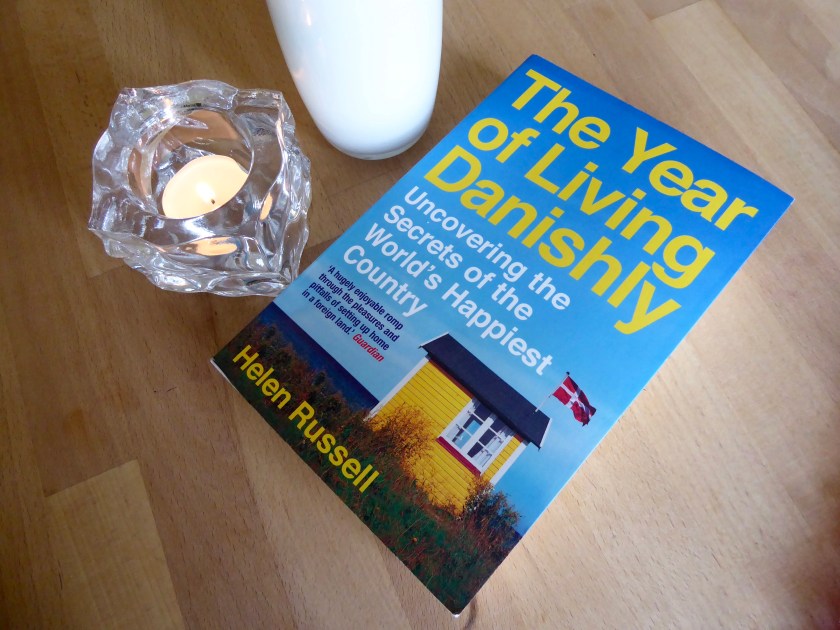
Review: The Year of Living Danishly

Helen Russell, former Marie Claire editor, is not exactly jumping up and down with excitement when her husband is offered a job at Lego in rural Denmark. As a Londoner she is used to the busy and eventful city life and Denmark has never been on her list of places to live. Discovering that Denmark has been ranked the happiest country in the world 40 years in a row, suddenly she sees a chance to report on a very popular life style topic – happiness – and maybe even find more of it in her own life. So she ventures out on “the happiness project” for one year in Southern Jutland, Denmark, together with her husband and dog.

Of all times they arrive in the beginning of January while the country is dark from 4 pm-9 am and everyone stay inside because of the snow, cold and darkness. It is a year full of challenges and Helen is not immediately met by happiness. But she soon falls in love with Danish pastry (in the beginning she eats one a day, haha!) and makes a great effort to immerse herself in Danish society.

She discovers that Danes love rules and tradition. It seems like there is a rule for everything – from when you can fly your Danish flag to how to use real nature in Christmas decorations. Pretty much everything comes down to tradition in Denmark and somehow Danes appreciate the predictability and use it to feel secure. In fact Danes feel so safe that they are one of the most trusting people in the World, so much so that they will leave their prams (with babies) outside stores and cafes and they even trust their politicians and queen!

She also discovers that Denmark has a great work-life balance and that it is normal to return from work at 4 or 5 pm. This is so unusual for her and her husband that they do not know what to do with all their new found free time until they learn that organized hobbies and sports are a big part of living Danishly. So she tries out everything from choir, drawing and an interesting evening swimming event that I shall not reveal here…

But aside from living very safe and organized lives Danes also love to have a good time and is one of the countries in the world with the highest consumption of alcohol, cigarettes and candles! Danes love to party and have hygge/coziness inside during the dark winters. Even at her husband’s workplace, Lego, they get cake and pastries on Fridays and have a funny tradition of singing about the work events of the week! And then there is the 52 weeks of joint parental leave and nearly free daycare. Denmark is the place to have children and Danish living is slowly growing on Helen Russell. I will let you find out for yourself if she finds the Danish happiness she is looking for…

I loved this book! Partly because it took me back to my home country and showed me Denmark with a outsider’s eyes, pointing out things in Danish culture I never even thought about and partly because it is so well-written and funny. Maybe the Danes have hygge but the British sure have their humorous sarcasm. This is the Danish version of Frances Mayes’ book Under the Tuscan Sun. It is a personal journey about finding a home in a new country which is written so well that it reads like a novel. Meanwhile it is full of interesting facts about Denmark through Helen’s interviews with Danish experts on happiness and culture. I would recommend it to anyone who is interested in Danish culture, happiness and hygge and especially to foreigners moving to Denmark. Even Danes in Denmark would get a healthy but loving laugh at their own culture.

Hygge, Coffee and Cake in the Good Old Days

The old photograph above from the early 1900s captures the essence of what hygge (togetherness/coziness) is. My Danish mother-in-law found it in an antique store in a town called Ørbæk on the southern Danish island Funen where she is from. Growing up on a farm on Funen she experienced this kind of hygge herself. She told me that they used to get coffee and cake three times a day! First at 11 am they would have coffee and cake, then at 3 pm they would have coffee, cake and cookies and at 8 pm they would have coffee, cake and cookies again!! And they did not just eat a piece of cake while doing something else. No, the family would sit down together for coffee and cake three times daily and of course also for the three main meals! Imagine all this togetherness/hygge throughout the day? I cannot help but wonder how they found time for this but maybe that would be the case if we got rid of all electronics? I bet the total time we spend looking at electronic devices could sum up to three times coffee and cake in a day.

This tradition of coffee and cake three times daily is a special tradition from Funen called “Fynsk Kaffebord” (or “Coffee Table from Funen”) but in general Danes do practice a lot of hygge with coffee and cake together. I would say once a day is more like the general norm. Hygge time brings people together and is a very relaxing form of being together where you just enjoy the break, togetherness and cake and no one is forced to be super entertaining. It is ok just to “be”…

I do not know about you but I find it extremely hard, even on weekends, to find time for this kind of hygge. There is always something I feel like I should do. Sitting down like that seems like a luxury – on the other hand something tells me it is not a waste of time and might be part of the reason why Danes are happier than any other nationality. Much research has shown that strong social relations is one of the most important factors for health and happiness. In fact a study by Brigham Young University and the University of North Carolina Chapel Hill put data from 148 studies together and found that people with poor social ties had a 50 percent higher risk of dying earlier than people with strong social ties. This means that strong social ties are just as important for good health as not smoking and even more important than exercise (see also Alexander and Sandahl in The Danish Way of Parenting, p. 131). What a great excuse for coffee and cake together with family and friends!

I could keep looking at this old photograph… The big pear trees in front of the classic old farm, the nicely dressed men and women (probably two families) and what might be a maid pouring coffee from a white porcelain coffee pot. In front of them is a bowl of something. Is it the classic apple cake from Funen, lemon cake or the so-called “Dream Cake”? This makes me dream… The men are smoking pipes, drinking schnapps and coffee and even the two women are having schnapps with their coffee! Lets not forget this is the country of viking men and women. It is either mid- or late summer and they have moved their table out in the court yard.

I might be a stupid romantic but it makes me want to recreate the same kind of hygge and “kaffebord” (“coffee table”) outside in the summer and try to embrace the slower pace of the old days, a slower pace with room for hygge that Denmark seems to hold onto – although maybe not three times daily anymore… I cannot wait to bring some good old-fashioned Danish cake recipes ala “Fynsk kaffebord” to you and inspiration on how to arrange your own coffee table to get more hygge in your life! So there will be much more on the topic of “Coffee Table”, old Danish cake recipes and the happy and hyggelige Danish island of Funen to come on this blog. For how can I let go of this fabulous topic of coffee, cake and hygge…?