Latest Posts

Interview with Iben Sandahl: Play – The Danish Way

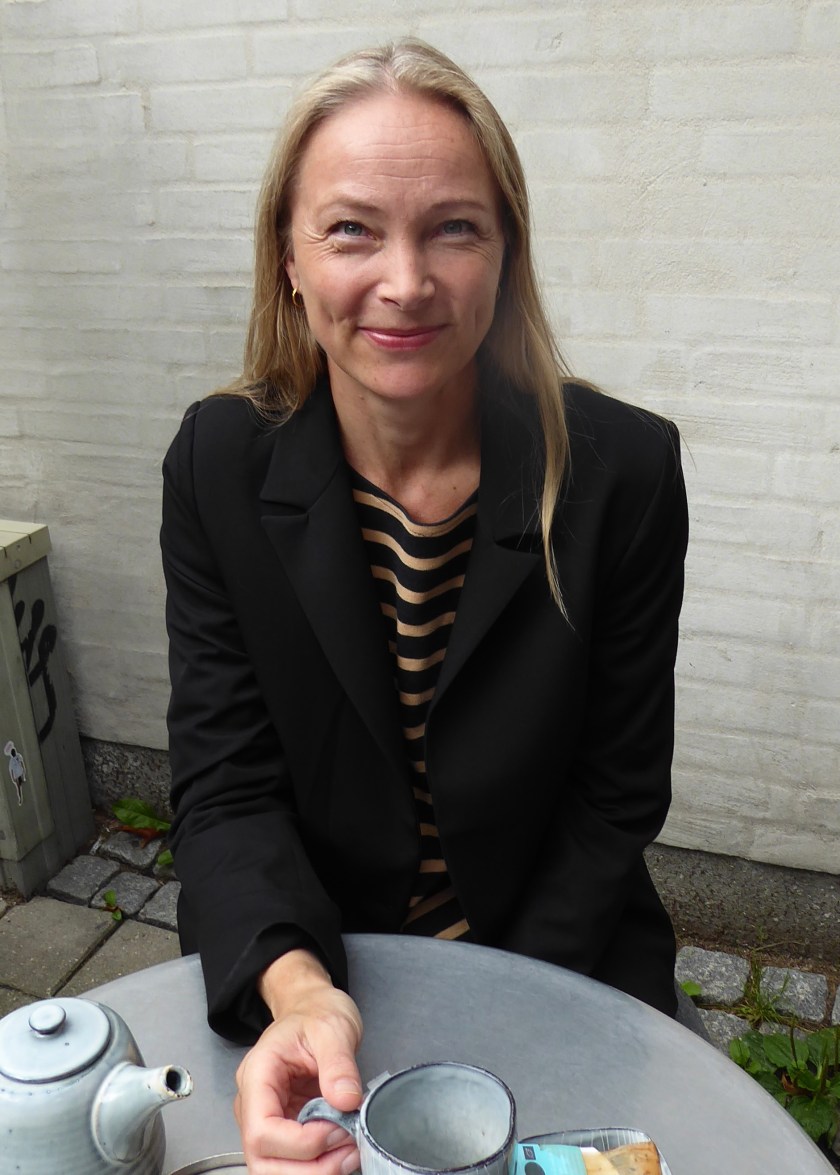
It is a beautiful sunny day in August and I am going to meet bestselling author Iben Sandahl for cafe hygge and an interview about her new book Play – The Danish Way. Excited to finally meet one of the two authors behind The Danish Way of Parenting I show up early at Cafe Mig og Annie in Lyngby, Denmark. Before I even begin to get nervous if she has forgotten about me, I see her arrive outside right on time. Even though I have never met her before I just know it is her. There is something radiant about her – the way she carries herself. She is stylish and beautiful yet relaxed and friendly and I immediately feel comfortable knowing that this is going to be a pleasant and interesting interview.

We find a table outside in the late-summer sun. While we warm up on big cups of cafe latte and green tea we start talking. Mostly about me. Iben is so engaging and warm that I almost forget that we are also here to talk about her and her new book Play – The Danish Way. So we agree to get started…

Me: What motivated you to write about free play?
Iben looks excited, then takes a deep breath and thinks carefully before she answers…

Iben: My deepest motivation is that I have a great wish that children should feel comfortable and have great foundations to unfold in a way that is giving and fruitful to them. I get claustrophobia when people are put in boxes and from demands that diminish diversity, when children aren’t allowed to flourish as who they are.

Me: Why is free play important?

Iben: I am a big advocate for free play and I think there is a danger of breaking the concept of free play into something that is a goal for adults, into something that is governed by a goal the adults have set. Play is not play if there is an agenda – when adults have decided that children should achieve or learn something specific through play.
Through free play children learn to cooperate, negotiate – and they do it all by themselves! Adult interference takes away the free choice. They learn about life through free play. Play can move them into a new developmental milestole they are ready for. Motivated by their own free will they take the next step in a direction they are ready for. In this way they mature. For example by seeing what other children can do, they can get a desire to learn how to do the same thing.

Me: Speaking of adult interference, I have a very hard time not interfering to protect my children i.e. on the playground. Is it really so harmful to interfere if you want to protect them?

Iben: When an adult warns and constantly reminds them of dangers and to be careful the adult harms the children’s confidence. The adult reminds them of a risk factor they have not considered themselves and which they suddenly have to considerate and they can become insecure. This gives them a feeling of not mastering what they are doing and that the adult doesn’t think they can do it. In this way you risk that they become someone who gives up instead of someone who conquers. There is nothing as great as the feeling of victory and of mastering something new. When you have done something you were not completely sure you could do and then do it. This strengthens the self esteem. If adults often warn and make them insecure they can damage children’s self esteem. Instead it is much better to support them if they need a hand and make them believe they are in control.

Me: How much time a day do children need for free play?

Iben: You cannot put time on it. It is very individual how much free play a child needs. There are also many facets of free play. Free play is time to absorb experiences from the day. So if a lot has happened one day, they may need more time for free play.
Personally, I give my daughters my full attention for about fifteen to thirty minutes after they come home from school. That’s all they need, but it varies of course. When they were little it was fifteen minutes of tumble time where they usually chose to tumble around on the floor with me (often on me), as older children it can be talking while having an afternoon snack together. When they have filled up their need for attention, they can do what they want (free play). It differs a lot what they need but it is a time they can fill up themselves however they want.

Me: When my daughter says she is bored as soon as I tell her to play alone, could it be because she is a highly social person and doesn’t need alone time?

Iben: As a stay-at-home mom or a working mom you need to be careful not to become a maid. It is healthy for the children to see that their mom also takes time to do something nice for herself and has important things to do. The mother is a rolemodel to them. Besides, it is good for children to learn to take initiative to something instead of always needing adults’ help and ideas. It can be a good idea to set a manageable time frame for them which they must fill out themselves. A no-disturb time. A mom-time. 15-30 minutes is a manageable time frame for the very small children, older children can handle up to one hour. If they come and tell you they are hungry, you can tell them they can have a sandwich but that now we will make it together so you avoid the service role. You can make it fun and into a shared project by explaining to them that mom needs mom-time and now we will go out and buy a timer together so we will know when it has been half an hour. It is a good idea to include the child and do it together.

Me: Until which age do children need free play? When are you too old for free play?

Iben: To that I will say never. Free play changes form with age but never stops. Adults also need time and to relax. Free play starts with the baby on its tummy by itself, exploring the world from there and later rolls and tumbles around. For preschool children play is very physical and is about testing limits. For older children, about 12-13 years old, play is more about immersion. It changes form and they can immerse themselves in an interest just because it is fun without a real goal and without being forced.
For adults free play is a free space i.e. to do exercise or a hobby. Something where the brain can relax and you can do something that makes you happy.
It is really good to show children that you can be silly. To be crazy. To be “not perfect.” When my children were younger we sometimes made a pact that we shouldn’t use napkins, while we were eating homemade burgers. We ended up having sauces all over our faces and we had so much fun. Doing what is not expected once in a while makes us human. We have also had a game where you walk through the living room in silly ways. Children love when you are crazy and silly. In this way you show them that you can be at their level and share their sense of humor – it connects. Just as long as you don’t do it all the time of course 😉

Me: Can you explain how free play leads to lower stress, more resilience, success and happiness?

Iben: Free play means that you, with your own free will, are allowed to explore, resolve tasks and gather information that you need. In this way your actions make sense to you and you create your own identity because you know that you can do something. You can trust yourself because you know that you can solve tasks and handle challenges on your own. Therefore you do not get stressed and will have more resilience when life later on offers challenges and new situations. I often say that you collect beads for a necklace which means that you create your own identity and thereby meaning with life. Self esteem is essential when you meet challenges. It gives you an increased sense of happiness. You believe in what you can do. When you focus on the process you feel more content instead of just achieving a goal and then hurry on to the next goal.

Me: How can we inspire children to more free play?

Iben: Parents can take a look inside first. Ask yourself which values you wish to pass on? Think of good memories from your own childhood and think about how to give this to your children. For example I have very fond memories of a summerhouse on the West Coast in Denmark where we were a group of children who would play around freely in nature.
You can create nice spaces for children to enjoy and play in. Spaces that invite children to use them. A corner with a mattress where they can lay down and daydream. A jumping or tumbling room full of pillows. You can put out crayons etc. so children can draw when they want to. Make spaces with facilities which children can grab and use if and when they want to.
And you can also set off half an hour to one hour a day for “own time” and tell them that they can use this time however they want. The only rule is that no one can disturb each other.

Me: What can nature give to free play?

Iben: Everything! You can find it all in nature. Nature inspires free play. Sticks, rocks, dirt – all of it…

Iben agrees that it is very hard to learn Danish parenting when you are not from Denmark. You have to learn a whole new way of thinking but she believes that it is possible. It is the same thing with the concept of hygge – it just takes time and effort to learn. In fact, Iben Sandahl and co-author of The Danish Way of Parenting, Jessica Alexander, were the first to introduce and conceptualize hygge to the world!
If you feel like you could use some more Iben Sandahl input and guidance in your life she is available for private family counseling on Skype all over the world! In fact, she tells me, she has very good experiences with counseling on Skype. She also travels the world giving lectures based on her books The Danish Way of Parenting and Play – The Danish Way. You can find her contact information and read more about her work on her website ibensandahl.com

I leave the cafe renewed and energized. Especially the idea about “own time” sounds appealing to me. And to create spaces that invite children to free play with things they can use when they want to. I finally understand that it is all about free will and learning to do things and explore on your own. This is so important for children as well as adults. Everything is easier when it is governed by our own free will. When we do something because we like it, and have fun doing it, our learning becomes so much better and faster. So why not get as much free play into our children’s lives as possible – I feel assured that this is the way to develop and learn in the best, happiest and healthiest way.



Realization upon Returning from Denmark


Just returned from Denmark and I wish I could have brought back all the people and places I love there, the beautiful design and local foods. But upon recovering from travel fatigue I realize that I am bringing home something far more important… a realization you can call it. That every place has its qualities and weaknesses and that being in Denmark is no guarantee for happiness. In fact, I feel happy to see my home in America again, my friends and my town that welcomes me back. Maybe the most important thing I am bringing home is this realization that the perfect country does not exist anywhere. Happiness is more of an attitude to life. An appreciation of what we have and a letting go of the yearning for what we do not have. This is something the Danes, generally speaking, are pretty good at. Taking time to enjoy things and people they love. Doing something joyful and relaxing is important to people of all kinds and ages. It clears our minds, we get the chance to recharge our batteries and appreciate the things we have and love around us. Fortunately, you do not have to be in Denmark to do this.

I will definitely not deny that my trip to Denmark was exciting and lovely and I cannot wait to share my experiences and all the great things I saw there here on this blog in the weeks to come. Just as long as we remember that it is only meant as an inspiration from Denmark because every place in the world has something great to offer. As a matter of fact it is a boost of energy to be back in the U.S. and to feel the American excitement, energy, hospitality and friendliness. When anthropologists go on long-term “field work” (research) it is recommended to take a so-called “field break”, for several reasons. The interesting thing is that when the anthropologist returns to the “field”  (the place they study) they usually become closer to that place and its people. Ironically, going away for a little while brings you closer. Now this has happened to me. I realize that I am not only Danish but also American and that it would be impossible to only live the Danish way. Maybe a more appropriate name for this blog would be Happy as a Dane – in America.

Weekend Cake: Brunsviger from Fyn

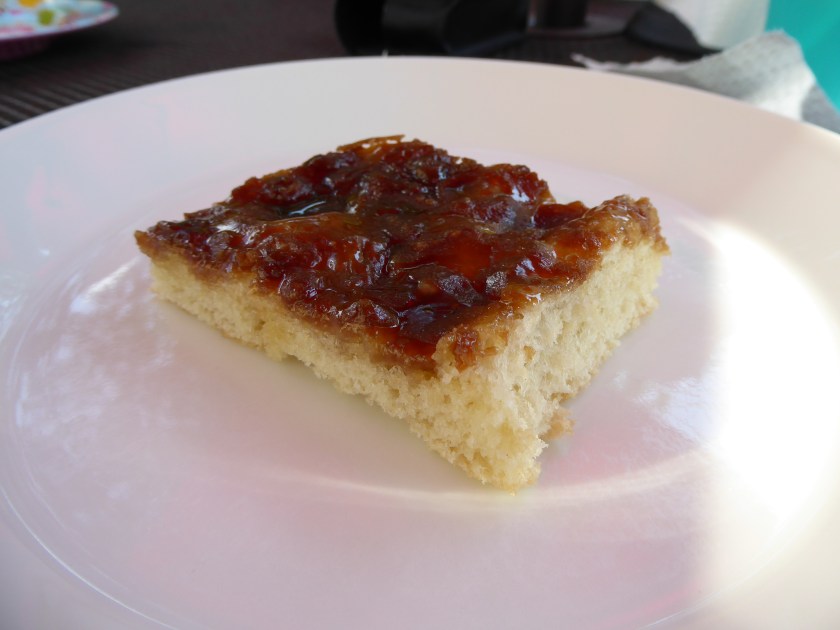
My husband’s absolute favorite cake is a Danish cake called “Brunsviger” originating from the small southern Danish island Fyn (Funen) where Hans Christian Andersen is from. I have no idea how to translate this name into English. It is a yeast bread with a caramelized brown sugar topping. You can find it in most Danish bakeries but there is a big difference between the Copenhagen version and the one from Fyn. Actually, it was not until my husband took me to Fyn where his family is from that I discovered how good brunsviger can be. Of course brunsviger is also delicious in Copenhagen but the version from Fyn tops everything. In Copenhagen the brown sugar topping is thick and sugary whereas on Fyn it is like a sirup-caramel topping. Apparently, it is so unique to Fyn that my husband told me to think of the rolling hills of Fyn when I shaped the cake. As you can hear he is very passionate about this cake and Fyn. This southern Danish island sure is beautiful with its lush fields and rolling hills, old farm and manor houses, idyllic coastal towns such as Svendborg, Faaborg and Kerteminde and a lot of beaches. The weather is even a tiny bit warmer than in the northern parts of the country – which is always very helpful in Denmark.


I found a great recipe for fynsk brunsviger on the Danish food blog Sesamsesam.com (here is the link: Opskrift paa fynsk brunsviger ).

For the non-Danes I have an adapted version of the Sesamsesam.com recipe here:

Fynsk Brunsviger Recipe

Dough Ingredients:

250 gram / 9 ounces all-purpose flour

25 gram / 1 ounce sugar

1 package active dry yeast

1/8 tsp salt

1 1/2- 1 3/4 dl whole milk

25 gram / 1 ounce butter, softened and cut into small cubes

Topping ingredients:

125 gram / 4.5 ounces butter

150 gram / 5.3 ounces dark brown sugar

4 tbsp sirup (maple sirup was delicious)

How you do it:

Heat the milk in a small pot until it is lukewarm. Transfer to a large mixing bowl. Stir in the yeast. Then you mix in the salt, sugar and flour. Add the butter and knead. Then you shape it into a nice ball and let it rise in the bowl in a warm place under a dish towel for about 30 minutes.

While the dough rises you make the topping by mixing all the ingredients in a medium sized pot over low heat until it is well mixed and melted.

Next you roll the dough out to a rectangle and fit it into a large metal baking pan (35 x 25 cm) with tall sides. Press a lot of holes into the dough (for the topping to run into). This is when you should think about shaping it like the rolling hills of Fyn. For more pictures on how to make the “hills” see SesamSesam.com Brunsviger Recipe.

Spread the topping evenly over the dough, cover with a dish towel and let it rise for about 30 minutes. After rising you press holes in the dough once again.

Now it is ready to bake for 12-15 minutes on 350 degrees fahrenheit (180 degrees celsius). Make sure to make it the same day as you wish to serve it because it is supposed to be eaten fresh. Already the next day it will start to get dry and you will have to warm it up to get the sticky tastiness back. It tastes extra good when it is a little lukewarm. Good luck! I hope you will love it too 🙂


Fairies, Merpups and Finding Joy When Things Don’t Go as Planned

In my last post I promised to give you an update on my use of the playguide in the book Play – The Danish Way by Iben Sandahl. I am not sure what happened but we went on vacation to Cape Cod and now suddenly half the summer has gone by. I am so excited that we have been electronics free for two entire weeks now (two hours after I published this post my kids were watching “Chuggington”… oops)! The absence of electronics has definitely made room for a greater imaginary universe but the summer still has not been as perfect as I imagined: me sitting in a garden chair, reading books while my children would play joyously for hours by themselves. A lot of times, I have had to dig deep in order not to get (too) frustrated with constant requests for help, questions about every possible thing (“why do people have swimsuits?”) and cleaning in 95 degrees fahrenheit with what seems like max air humidity (Maryland summers are tough for a Dane!). But I will save my realization about finding joy on less than imperfect days as a bonus in the end of this post. First, I will tell you how the playguide has helped me have more hygge, fun and play with my kids this summer.

Hygge is the first theme in the Playguide. Hygge with kids is a great way to create a nice atmosphere that will inspire joyful play plus allow the adult some much needed downtime. My favorite way to hygge with my children is to read stories that we all love such as H.C. Andersen’s fairytales, Peter in Blueberry Land or Blueberries for Sal. It is a great excuse to get to revisit stories from my childhood and look at beautiful illustrations. So while you might not get to spend days in art museums or sit and read novels for hours straight, this is one way to get some art into your life that both you and your children enjoy. We also love to dance and go for adventurous nature walks. Whatever you like to do, sharing something you love with your children is a great way of enjoying some togetherness/hygge.

Making things together is another idea from the Playguide. My daughter and her friend love making fairy houses and decorating them with flowers. Tree bark makes great construction material, shells become fancy sinks and bathtubs, moss provide soft fluffy beds and dried flowers add scents and colors to the interior decoration for the fairies.


Our vacation on Cape Cod has revitalized my children’s fascination with mermaids so finally my childhood’s endless hours of practicing how to draw pretty women has come to use. I draw the mermaids and the kids color them. In the end we will have a nice little mermaid picture book. My son’s request for “merpup” drawings (from Paw Patrol) is something I will have to work on later though… I love these kinds of crafts where I do not have to look up ideas on Pinterest and buy a million art supplies. Nice, simple and open-ended so you can truly get to create something out of nothing.

P1010928

I am hoping that my children will become so fond of drawing at the kitchen table that soon there will be no requests for TV while we cook and instead they will prefer exploring their own creative abilities.

But as I said, our summer has not been all faires, flowers and mermaids. Yesterday at the breakfast table I was finally able to read a few paragraphs in a magazine when my daughter said: “There is something yucky on the table!” Much against my will I took my eyes off the magazine that I had been trying to read for days and saw her pointing at something I badly wanted to brush off as “just some flaxseeds”. After a few seconds my sense of motherly responsibility returned and I had to admit that it sure did resemble feces from a mouse!! On our dining table, in the summer, while we were eating!! It took me up to half an hour to get over the frustration of having to sanitize the kitchen on one of the hottest and most humid days here in Maryland. But magically the children understood my need to recover from disgust and annoyance and started creating a role play on their own in the playroom. Suddenly what had started out as a bad morning became a morning of fun and free play with not a single sibling dispute. I heard them making dramatic and fun sounds for a whole hour while I mopped the floor and spritzed every surface. I even got the chance to play some loud music and think thoughts unrelated to parenting! This is when I realized that all they need to know is that sometimes their parents are not available, parents also have other things to do that are important and that they will be perfectly able to play by themselves. In fact, children have way more fun when they make up their own play and learn so much more from it. Strangely enough, the mouse visit became some sort of odd gift that proved how great children are at using their imagination and playing on their own – and how beneficial it can be for everyone to tell your children to leave you alone every now and then…

To take your mind off mouse feces here is a picture of wild roses on a Cape Cod beach just like on the Danish beaches. There is definitely lots of Danish happiness to be found on Cape Cod and its many beaches…

There are many more ideas on how to inspire more free play, fun and hygge for your children in Play – The Danish Way and I will let you know how it goes trying some more of them out.

image1

Wild Rose on a Cape Cod beach. Photo by Christian West.


Play – therapy for the mind and soul

“I never want to grow up,” he (Tommy) said determinedly.

“Me either,” said Annika.

“No, that isn’t something to strive for. Grown-ups never have fun. They just have a lot of boring work, stupid clothes and calluses and taxes.” (….)

“They don’t know how to play either,” said Annika. “Ooh, that you are forced to grow up!” (free translation from Astrid Lindgren’s Pippi Longstocking in the South Seas, 1948)

Last night as I was reading Pippi Longstocking to my children we came across this great passage where the children, Tommy and Annika, tell Pippi that they never want to grow up because adults aren’t fun and don’t know how to play. To this Pippi replies that growing up isn’t something to strive for and then she offers the children some magical pills to prevent them from ever growing up.

This may just seem like a funny statement because growing up is, of course, something to desire and adults always know best. But do we really? Do we always know what is best for children or are there some things they know better? Like, how to play. Haven’t most of us lost the capability of playing? Speaking for myself, I get bored after just ten minutes of playing, often less… In fact, I get exhausted. Back in college as an anthropologist in training my first fieldwork was in a preschool trying to find out what free play is all about. My friend and I joined the preschool world, not as teachers but as children, studying things from their perspective. This might have been even more mind opening than when I later studied foreign cultures far away! I remember how we would have a headache just from trying to truly enter their world and see it with their eyes. If that is how hard it is for adults to understand children’s culture, imagine how hard it must be for children to make sense of the adult world…

The book Play – The Danish Way by Iben Dissing Sandahl, published a couple of years ago, seems more relevant now, during the Covid pandemic, than ever as a reminder that what children really need to stay sane and happy is to play with each other. You could almost say it is their form of therapy where they process and make sense of daily experiences and a strange world. In the world of play they regain a sense of control and agency which can be hard to gain in the confusing world of adults. The book follows up on Iben Dissing Sandahl and Jessica Alexander’s international bestseller The Danish Way of Parenting which created a wide interested in how to help children enjoy unstructured free play. It is also a great book to read here in the summer where children have what seems like endless time. It provides the readers with a great opportunity to encourage free play both for the sake of their children’s healthy and happy development and for the sanity of their parents. All that parents really have to do is to create a playful environment and then leave the kids to themselves because they know much better than us what to do!

Free play is so more important for children’s development than many of us parents realize. Before I read this book, I viewed play as a way children pass their time. Just fun, or maybe even a waste of time compared to going to sports, extra curricular activities or story time. I did not take it as seriously as I should have. In fact, free play is one of the most crucial factors for healthy childhood development. Play is children learning on their own. Coming up with new creative ideas, experimenting, learning by mistakes and thinking and acting independently. Most of our world is designed by adults with adult rules and decision making. In free play children gain freedom and autonomy to create their own world, however they want it. By playing with other kids they learn how to interact and socialize, not because an adult tells them how they should behave but because they experience the consequences of their actions on their own. These skills from play are so important, also for how they do in school and fair later in life. Through free play children develop the ability to think creatively and to take initiatives instead of always needing adult guidance. But most importantly – free play is a a cornerstone in parenting happy children who are emotionally, socially and physically healthy and resilient.

Unfortunately the amount of time that children spend on free outdoor play has dropped by 90% since 1970. Meanwhile, attention disorders, narcissism and even lack of physical skills have increased by a lot. Play – The Danish Way is a great reminder of the value of children’s magical and fun universe. And the book not only reminds us to treasure children’s playtime, but also our own. Adults can and should still play – it is what happens when we become so absorbed in a project that we forget about time. Just like when a child refuses to go home because they are having a fun time playing with their friends. The same thing happens to adults every now and then when we create or do something we enjoy. Innovating, thinking and being creative is play and as a society I hope we will all keep up this ability. A playful home where parents show that they like to play – have hobbies, interests and fun – is encouraging for children’s desire to play. For your inspiration the book includes a play guide with ideas on how to facilitate your children’s desire to play and there are many things adults can do to help the play along.

I cannot encourage this book strongly enough. It provides the readers with a positive, warm and fun-loving view of the precious childhood without lecturing and preaching. Iben Dissing Sandahl writes with a love and passion for childhood which she passes on to her readers. Moreover, it is quick to read, well-structured and has many eyeopening and useful insights with a good balance of research and tangible examples. So parents, don’t feel bad if you are exhausted from entertaining your kids and have run out of stimulating activities. You will actually do them a favor by taking a step back and relax sometimes. Let children enjoy their world and create with their own imagination!

Below follows the full excerpt from Pippi Longstocking (freely translated from Astrid Lindgren’s Pippi Longstocking in the South Seas, published in 1948):

“I never want to grow up,” he (Tommy) said determinedly.

“Me either,” said Annika.

“No, that isn’t something to strive for. Grown-ups never have fun. They just have a lot of boring work, stupid clothes and calluses and taxes.” (….)

“They don’t know how to play either,” said Annika. “Ooh, that you are forced to grow up!”

“Who said you have to!” asked Pippi. “If I’m not mistaken, I have some pills somewhere.”

“What kind of pills,” said Tommy.

“Some really good pills for those who don’t wish to grow up,” said Pippi and jumped down from the table.

I don’t know about you but I will try to find one of those pills for myself too and keep what is left of innocence, fun and magic. Apparently the pills look a lot like peas…

A Summer of Free Imagination – Let the Kids Be Bored and Play


“Mom I’m bored, can I watch something?” says my five year old like it is the most terrible thing that could have happened to her. We have just been out for a kid event and now five minutes later she is already bored. I feel highly tempted to turn on that pony show so I can get half an hour to get some stuff done. But I stand firm and say “No, it is good to be bored – now you can come up with something yourself.” She looks at me perplexed but leaves the kitchen. Sure enough, ten minutes later I hear her singing and talking while she plays with her dolls in the family room. Yet every time she catches a glimpse of me she tries to talk me into entertaining her and I have to neglect all my feelings of guilt and let go of my inner pressure to constantly stimulate her. It helps me to know that letting children be bored and play by themselves, or with other children, is actually one of the most important things in their development… Boredom is good! Or rather the free unstructured play that children come up with without adult input is crucial for their ability to think outside the box. This is how they absorb and process their experiences and learn to be creative and imaginative. In fact children need three hours of unstructured play, preferably outside, every day according to Angela Hanscom, pediatric occupational therapist and founder of TimberNook and author of Balanced and Barefoot (Article on outdoor play)

It is not only children who want to be constantly entertained instead of creating and imagining things on their own. I recently read an article on BBC.com about an airline that had responded to the ban on carrying electronic devices on certain flights by providing passengers with a list of 12 things to do without a tablet or laptop (read article here: Why Idle Moments are Crucial for Creativity)! Like read a book or daydream. I cannot believe that we are getting to the point of not knowing what to do without electronics! What happened to independent thinking and imagination? The irony of it all is that we all – adults and children – appear to be much happier when we put our iPhones and iPads away. Of course it takes a while to get over the cravings, just like with sugar or alcohol, but after a day or two it is actually very peaceful not to check the internet or text messages all the time.

Last week our family had staycation at our house where we left the iPhones attached to their plugs like old-fashioned landline phones and only checked them once a day. The kids did not watch any tv. Instead, we spent time relaxing together doing yard work while the kids played outside. It definitely also helped that their grandparents stayed with us for a while being fun and playful. This inexpensive vacation ended up being one of our best vacations! Everyone relaxed and felt happy spending time together instead of in some non-real world online. No deadlines, no schedules, no stress – or rather we just forgot about our commitments… and it was great!

So my goal for this summer is a “go-with-the-flow” attitude where we make the most out of not having to get ready for school every day. This is my chance to undo my own and my children’s screen addiction. Our chance to enjoy the freedom of long days of free play that is not squeezed into a tight schedule. I hope for a summer of fairies and dump trucks, dirt and flowers, endless amounts of berries and lemonade, lounging on the beach or by the pool. A summer where the mom (me…) will not care about sand or grass carried inside on wet shoes, about swimsuits and towels drying all over the house because her imagination has made her house into a “beach house” and she is on vacation even when at home.

Dream Cake from Brovst

Dream Cake from Brovst is such a classic from my childhood in Denmark. Originally invented by the Danish woman, Jytte Andersen, who took part in a baking competition in 1960 in the Danish town Brovst, Jutland (See Droemmekage on Wikipedia). This woman would be a millionaire if she had got the copyrights for the recipe because it is a favorite everywhere in Denmark. So much so that it was voted the fourth most popular cake in Denmark in a cake research/questionnaire conducted by the newspaper Metroexpress. I have already received feedback from enough Americas to know that this cake will become a classic over here as well.

It is similar to a pound cake – heavy and moist with lots of eggs and butter. But it is the topping with coconut and brown sugar that makes it. It is pretty simple to make and will be a hit at any social get-together.


Droemmekage fra Brovst / Dream Cake from Brovst Recipe

Ingredients:

250 gram / 9 ounces all-purpose flour

3 tsp baking powder

50 gram / 2 ounces softened butter

250 / 9 ounces gram sugar

1/8 tsp salt

1 tsp vanilla extract

4 eggs

2 deciliter whole milk

For the topping:

130 gram / 4.6 ounces butter

260 gram / 9.2 ounces brown sugar

125 gram / 4.5 ounces shredded coconut

3/4 deciliter milk

A large rectangular metal baking pan with tall sides (38 x 24 centimeter or 15 x 9 inches).


How you make it:

Mix flour and baking powder in a medium bowl.

Beat butter, sugar, salt, vanilla in a mixing bowl until creamy and soft. You have to beat for a long time. Beat in the eggs, one at a time and for a long time. Add some of the flour.  Stir in the milk and the remaining flour.

Then you cover the baking pan with parchment paper so it is covered all the way up on the sides and bottom. Pour the batter into the pan and bake it on 390 degrees fahrenheit in the middle of the oven. Bake for 20 minutes. When a chopstick or another stick comes out clean it is done.

While the cake bakes you boil butter, coconut and brown sugar in a medium pot while constantly stirring.

When you take the cake out of the oven, you spread the brown sugar and coconut topping evenly on it right away and put it back in the oven to bake for another 6 minutes on 440 degrees fahrenheit.

The cake can be served when it has cooled off. You can can simply cut the pieces out in the baking pan and serve as is. And don’t forget the coffee!


Danish Pancakes

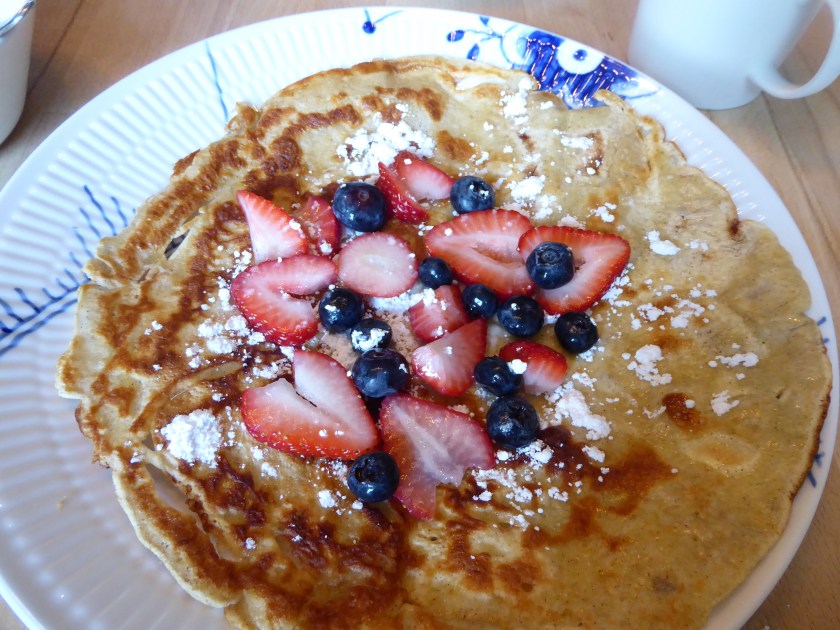
It seems that every country has its own version of pancakes – Denmark included. Some would say there is nothing more Danish than pancakes and that Danish pancakes are certainly a way to Danish happiness. Danish pancakes are typically an afternoon treat that often end up becoming dinner as well because the kids will eat so many that there is no room for anymore food that day. They are very similar to French crepes, topped with whatever you like but strawberry/raspberry jam and powdered sugar is the most classic version. I guess the Danes just love their red and whites! I enjoy a summer version with fresh berries and powdered sugar sprinkled on top. Banana slices and nutella works too.


Danish Pancake Recipe

Ingredients:

4 eggs

8 deciliter/3 cups whole milk

400 gram/14 ounces all-purpose flour

2 tbsp sugar

1/4 tsp salt

1/4 tsp vanilla extract

Butter for frying

How you make them:

In a medium sized bowl beat together the eggs and flour while adding the milk a little at a time. When the dough is smooth you add sugar, salt and vanilla extract. The dough will be much thinner than American pancake dough. Cover the bowl and set aside in a cozy place for about 1/2 hour.

Then you heat up a frying pan and melt one teaspoon of butter on it. Next you pour about 1/4 cup of pancake dough on the pan while you move the pan around so the dough is evenly divided on the whole pan. When the dough is light brown on the edges you flip it with over and fry it on the other side until it is golden brown on both sides. Transfer it to a plate covered with aluminum foil. Then you melt about a teaspoon of butter on the pan and start frying up a new pancake and so forth until you have a nice stack of pancakes. My children usually eat them while I make them so I never get a stack. The pancakes disappear quickly!

Serve them with a selection of different toppings – such as strawberry or raspberry jam, powdered sugar, nutella, berries, banana slices – so people can design their own pancakes.  Putting toppings on is an important part of the fun! Roll them up and eat them with your fingers.

Hindbaersnitter / Raspberry Slices of Happiness

Summer and heat is here and hygge has moved outside. Outdoor summer hygge makes me crave the Danish pastry called “Hindbærsnitter” or “Raspberry Slices”. In fact, I cannot think of a happier cake than a Hindbærsnitte (except for maybe a cupcake or birthday cake). Just take a look at it! A real slice of happiness… Raspberries on a flaky crust glazed with sugar to give you that happy kick. And kids seem to go crazy for them – just cut the slices into halves for small children so the sugar doesn’t make them go truly crazy!

Hindbærsnitter have a lot in common with Pop Tarts but are not quite the same. You can find Hindbærsnitter in every Danish bakery. It is a true Danish classic. Good news is that you do not have to travel all the way to Denmark to bring them to your coffee table – they are actually pretty easy to make! So here you go – a recipe on how to make your own slices of happiness:-)

Hindbærsnitter / Raspberry Slices Recipe

Ingredients:

300 gram / 10.6 oz all-purpose flour

100 gram / 3.5 oz confectioners sugar

200 gram / 7 oz butter, softened

2 egg yolks

250 gram /8.8 oz raspberry preserves with seeds

Icing:

270 gram / 2 1/2 cups confectioners sugar

4 tablespoons cold water

Multicolored sprinkles

How you do it:

Mix butter, flour, confectioners sugar in a mixer with paddle attachment or just with a spoon until crumbly.

Add the egg yolks and increase the mixing speed and mix until the dough is smooth and forms a ball but do not over-mix. Cover the bowl with plastic wrap and refrigerate for about 30 minutes.

Divide the dough into two. And here comes the trickiest part – at least for me – rolling each ball out on parchment paper so it forms a square of 25 cm 25 cm (9.5 x 9.5 inches). The dough kept sticking to the rolling pin. It helped to knead in a tablespoon or two of cold water and keep the rolling pin covered with flour. You can also use your hands to flatten the dough out. Repeat with the other dough ball.

Transfer each square of dough on parchment paper to a baking sheet. Then bake them one at a time for about 12 minutes on 390 degrees fahrenheit until light golden. Cool down for about 15 minutes.

Stir the raspberry preserves so it becomes more liquid and then spread it evenly on top of the first cake. Then carefully transfer the second cake piece on top of the first.

Mix the icing in a bowl. If necessary, carefully add a little more cold water drop by drop until it is thick and smooth like syrup. Cover the top piece with icing and spread the sprinkles over immediately after so they will stick.

Now you have to wait till the icing is completely dry before you cut it into 12 pieces or more. Use a big sharp knife and cut with a press, not a sawing motion. You might also want to cut the edges of so the slices are nice and straight on the sides.

The second hardest part is that you have to wait until the frosting is completely settled before you start eating. I recommend waiting a couple of hours before you serve them because they will taste better then.

And don’t forget to serve them with coffee – or a glass of cold white wine. They can be stored in an airtight container for several days. No need to refrigerate.

Recipe adapted from Mydanishkitchen.com

So, my “Friday Cake” series has ironically caused me more stress than hygge because I rarely have time to bake, hygge and write on Fridays plus it has turned me into a heavy sugar addict (Danish cake portions are really meant to share with guests…). And after all, what is the point of a hygge cake if you are so busy baking that you do not get to the hygge part? From now on I am just going to bake and post cake recipes when I have someone to bake them for and the time for it. This does not mean there won’t be more cakes on happyasadane – just not every week. I am already excited to try out more Danish cakes so lets see how long I can wait…

The Essence of Hygge

I have been trying to come up with a definition of the “essence of hygge” or the “basics of hygge” and I think my conclusion is that the essence of hygge is taking your time to enjoy something. Or in other words, hygge means no stressing or rushing. Even coffee and cake is no guarantee for hygge if you don’t take your time to enjoy it. Imagine indulging in a nice sweet and sticky piece of cake with a cup of hot brew and then suddenly you discover that you have to leave the house in two minutes? Gone is all the hygge in a flash of a second!

Almost anything can be hygge as long as you do not stress or rush through it. That is why I think the most important factor for hygge is the absence of stress or rush. You have to allow yourself to take your time in order to get that hygge feeling.

Hygge does not have to include wool socks, hot chocolate, cake or a lamb skin throw (although all these things certainly help). All you really need is the time to enjoy the pleasure of being in the moment. It can be enjoying your shower for five minutes longer, taking your time while carrying out everyday tasks such as cooking, baking or watering the flowers. If you play nice music and turn on some warm lights you can create an atmosphere that encourages you to get into the hygge feeling even while cooking. Maybe even while folding laundry… although I think it might take a lot of hygge-practice to be able to enjoy that one…

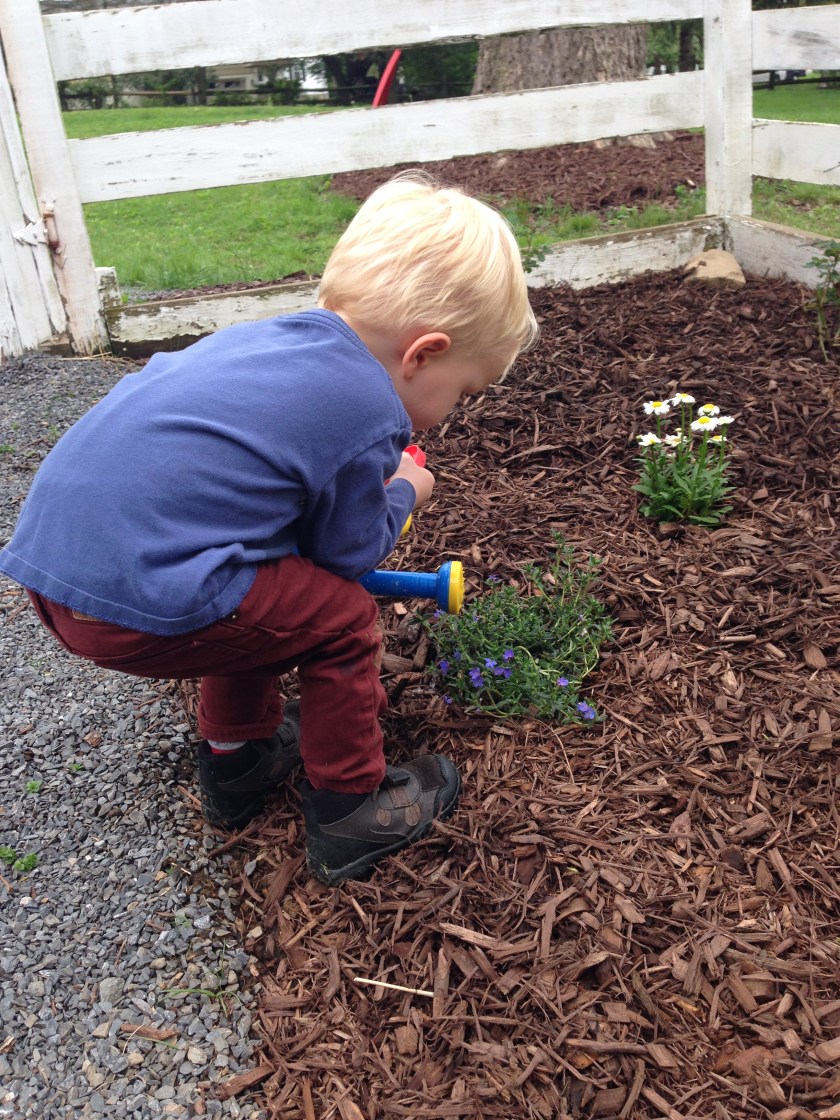
The other day I was in the backyard with our two-year old son who is my little “hygge mentor”. Eager to get inside for lunch I was about to rush him out of his hygge time in nature when we suddenly discovered a beautiful caterpillar with lightblue dots on a burned orange background. We had never seen anything like it and he enjoyed touching it and tried to feed it like a little pet. There we sat for one of those moments where you forget about time – and even hunger – while the sun warmed us and made the moment even more beautiful. It is one of those “Golden memories” that I can see clearly in my mind even though I did not get a photo of it. I was too absorbed in the moment. Yet again, our little son showed me how to take time to enjoy some hygge instead of rushing.

This is what hygge is all about – seizing opportunities to enjoy the simple pleasures that life offers us. All around there are lots of things just waiting to be turned into moments of hygge and joy! Maybe you could even go as far as to call hygge a form of everyday meditation as you create a moment where you focus on the joy of the moment and forget about stress and worries for a little while. If you have comments on this topic or would like to share some examples of how you get hygge into your life I would love to hear from you. You can leave a comment below or contact me on happyasadane@gmail.com. Thank you!

IMG_1026

My little “hygge mentor” in his “hygge-pants”…